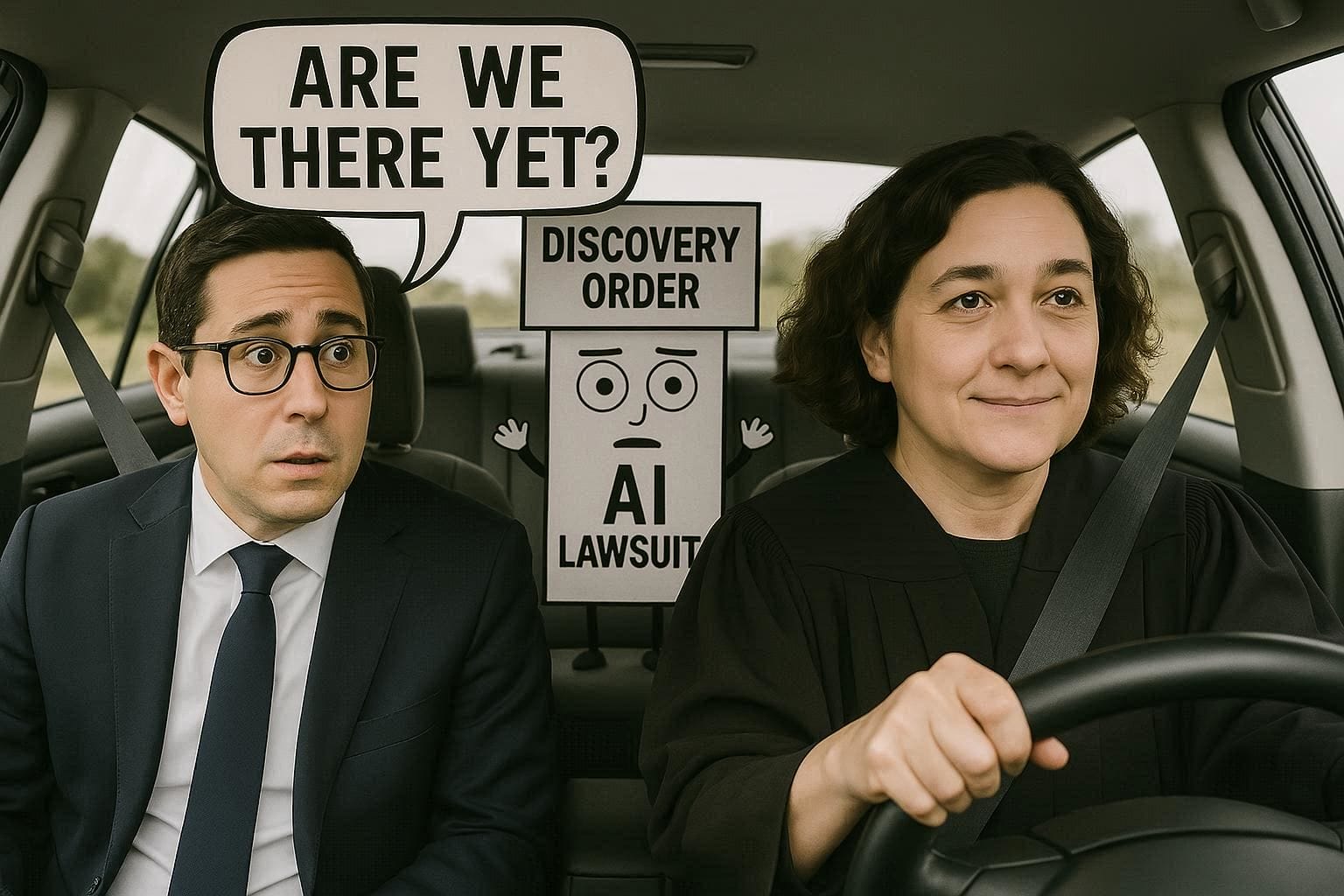
Waiting for eDiscovery decisions to come through the courts can feel like the longest road trip ever. There is always someone who wants to know, “Are we there yet?” This may be partially because eDiscovery by definition is centered on electronically stored information. As such, the practitioner is frequently dealing with new and innovative devices, applications, and data that move at a faster pace than the courts. As practitioners for more than 20 years, Digital Mountain has learned to exercise a little patience when waiting for the courts to lay down the law on eDiscovery issues. That does not mean, however, that we are apathetic when the big decisions come down. In fact, there have been some recent decisions regarding discovery of Gen AI prompts and responses that definitely have our attention.
The case that seems to be on everyone’s watch list is IN RE: OPENAI, INC., COPYRIGHT INFRINGEMENT LITIGATION, 25-md-3143 (SHS) (OTW) which has been part of a consolidated Multidistrict Litigation in the Southern District of New York since April 2025 and brought together the following cases:
The proceedings include a plethora of Discovery related opinions, orders, and memoranda, including a strongly worded and heavily formatted order from Magistrate Judge Wang that reads:
Judge Wang’s Order to preserve “all output log data that would otherwise be deleted” could affect more than 700 million weekly active users provided ChatGPT hit its August 2025 estimate (source). For clarity, an output log can include the responses generated by, in this case, ChatGPT, as well as potential tokenization information, and data from function calls. In short, what Judge Wang ordered was for OpenAI to retain all its output from ChatGPT that would have otherwise been deleted by either user request or by law. After some pushback by OpenAI, the presiding judge, Judge Stein, affirmed Judge Wang’s decision in June 2025 (Order).
More recently, Judge Wang signed an Order denying OpenAI’s request for the Plaintiff, The New York Times, to produce content from their employees’ interactions with ChatExplorer, an internal tool owned by the New York Times and built with OpenAI’s API. For an interesting discussion on why the motion was denied, the Opinion & Order is worth a read. This Order was signed on September 19, 2025, and displays how this case could continue to produce fascinating case law for months, if not years, to come.
Rarely do we focus on just one case, albeit a large, consolidated case, when we are writing about case law of interest to eDiscovery practitioners. However, when we looked at other recent developments in copyright cases, such as CONCORD MUSIC GROUP, INC., et al., v. ANTHROPIC PBC, Case No. 24-cv-03811-EKL (SVK), (US Dist. Ct. N.D. CA), what we see are multiple citations to cases that are members of IN RE: OPENAI, INC., an indication that this case, of all cases, may be the one that brings us all the way to the our final destination: precedence.