Courts can hear dead people. Just not their ghostwriters.
The law has always let the dead speak on the condition that the words must be their own. The rule is called the dying declaration. It is one of the oldest exceptions to the ban on hearsay, and it survives today in Federal Rule of Evidence 804(b)(2). If a person believed death was imminent and spoke about its cause or the circumstance, the statement is admissible, even though the speaker can never be cross-examined. You can doubt that theory, and plenty of judges have. But the rule shows what the law requires, not whether the words move us. What’s required is that the words are reliable and that the speaker is unavailable to testify.
In November 2021, Christopher Pelkey and Gabriel Horcasitas were stopped at a red light in Chandler, Arizona. Horcasitas honked repeatedly at Pelkey’s truck. Pelkey, a 37-year-old Army veteran, got out, unarmed, and walked toward Horcasitass car. Horcasitas shot him. A first-degree manslaughter conviction was thrown out because prosecutors withheld evidence; a second jury convicted him in 2025. On September 30, 2026, an Arizona appeals court ruled on the two elements of a dying declaration regarding an AI-generated video State v. Horcasitas, No. 1 CA-CR 25-0191 (Ariz. Ct. App. Sept. 30, 2026). In it, a dead man in a gray baseball cap forgave the man who shot him. He never said a word of it.
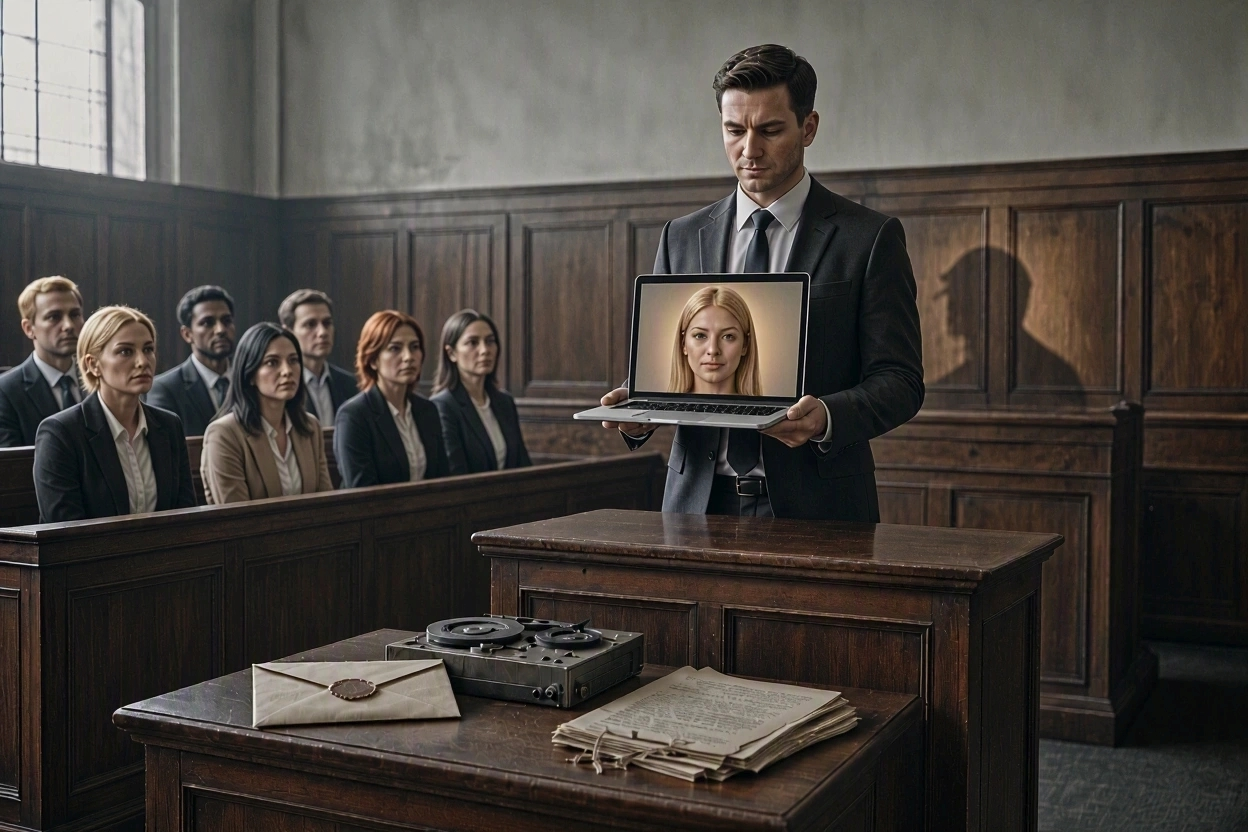
At the May 2025 sentencing, nine of Pelkey’s family members and friends spoke. Then the court watched a video. Pelkey’s sister, Stacey Wales, had built it with Generative AI technology from an earlier recording of her brother, a photograph, and a script she wrote herself. The digital Pelkey addressed his killer directly and offered forgiveness. The judge was moved. He remarked on the obvious forgiveness in the statement and said he loved the AI. The state had asked for nine and a half years. He imposed ten and a half, the maximum.
Then in September 2026, the Arizona Court of Appeals vacated that sentence and sent the case back for resentencing. The conviction stands. The video, the court said, did not document an event or capture a real moment. It showed Pelkey’s thoughts as his sister imagined them, and in doing so it crossed that line. The defense had pressed two points that should sound familiar to anyone who handles digital evidence. The video never disclosed who wrote Pelkey’s words. And nothing in the record showed those words reflected what Pelkey actually thought.
The Death of Privilege?
The Pelkey video was a single recording, made for a single sentencing hearing. It spoke once. The companions now on the market are built to keep talking. Companies already offer AI replicas designed to sound like someone who has died, trained on that person’s texts, emails, voicemails, and letters. People talk to them every day. That raises a question few of the people building or buying these products have asked: what happens to the privilege that protected some of those words?
Consider a widow who uploads thirty years of her husband’s messages to build a replica. Many of them are confidential marital communications. That privilege protects private words between spouses, and in most jurisdictions, it does not end when the marriage does, by divorce or by death. The law treats that privilege like a promise of confidence made at the wedding. But the privilege has a well-known weakness: voluntary disclosure to a third party generally waives it. An AI technology company is a third party. It stores the material, and its terms may let it review or use it. In United States v. Heppner (S.D.N.Y. 2026), Judge Rakoff held that a defendant’s conversations with an AI model were not privileged, in part because the provider’s privacy policy undercut any expectation of confidentiality. That was attorney-client privilege, but the reasoning travels.
So, grief may unlock exactly what the law meant to keep closed. The widow did not mean to waive anything. Courts have not always found that relevant; a waiver can stand even when the person does not grasp its consequences. And the replica creates new evidence of its own. The uploaded source material, the survivor’s prompts, the replica’s replies, and the account logs are all electronically stored information. If that replica ever says something that matters in a dispute, a court will face the Pelkey question again. Whose statement is it: the dead husband’s, the widow’s, or the company’s?
The record, not the voice
The ghost in the machine is literal now, and courts are deciding what it may say. The rule emerging from Arizona is the same one behind the dying declaration: the dead can leave a record, but they cannot leave a voice. Their real words can be preserved, authenticated, and weighed. Words written for them are someone else’s testimony, whatever face delivers them.