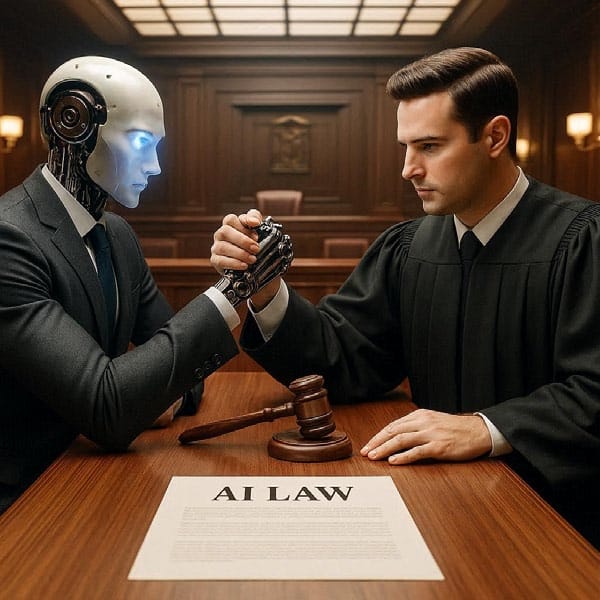
The year 2026 could mark a shift in artificial intelligence regulation. While policymakers debate frameworks and agencies issue guidance, judges will render decisions that establish precedent for decades. Major legal battles in constitutional law, regulatory economics, and tort liability will answer questions of who has authority to regulate AI, who bears the cost of AI infrastructure, and who is liable if AI causes harm. The outcomes will define the legal landscape of artificial intelligence far more decisively than any congressional hearing.
Federal Preemption of State AI Regulation
A patchwork of state and local AI regulations is creating the exact scenario the Commerce Clause was designed to prevent. California mandates bias audits for hiring algorithms. Colorado requires impact assessments for high-risk AI systems. New York City regulates automated employment decision tools. Each imposes different compliance requirements making a legal challenge all but inevitable. Either the federal government or commercial industry likely will invoke the Commerce Clause, arguing that state AI regulations burden interstate commerce. The question before courts, likely reaching the Supreme Court as early as 2026, is whether AI regulation resembles data privacy, where states have latitude despite some federal framework, or telecommunications, where federal law largely preempts state authority.
The stakes extend beyond AI. A Supreme Court decision invalidating state AI laws signals that regulation of emerging technologies belongs at the federal level. On the other hand, upholding state authority would greenlight continued legislative experimentation and escalating complexity. For obvious reasons, business interests favor federal preemption for regulatory certainty. Consumer advocates and states defend their authority to protect residents from AI harms the federal government has failed to address. The eventual case that comes before the Supreme Court will establish precedent that shapes technology regulation for generations.
Data Center Energy Costs: Utility Rate Litigation
Artificial intelligence’s explosive growth carries a hidden cost on consumer utility bills. AI training and processes demand unprecedented electricity, and utility providers are building massive infrastructure in response. Under traditional rate structures, those infrastructure costs are distributed across all ratepayers, meaning residential customers and small businesses subsidize the buildout for AI companies’ data centers (read more here).
Legal challenges will emerge most likely through class action litigation against utilities and public utility commissions in states experiencing rapid data center growth, such as Virginia and Texas, where utilities have courted AI infrastructure. Plaintiffs may argue that cost allocation formulas violate principles requiring rates to be just and reasonable. When a residential customer’s bill increases twenty percent while their usage remains constant, but a massive data center receives preferential rates despite consuming exponentially more power, has the utility violated its obligation to allocate costs fairly? During power shortages, can utilities legally prioritize data center delivery over residential needs?
Questions such as these will force courts to scrutinize utility commission decisions that approved rate structures favoring data center development. Utilities may defend cost allocation as economically rational because data centers bring jobs and tax revenue. Plaintiffs may counter that communities bear costs while shareholders and tech companies profit. The litigation will determine whether AI’s energy appetite is a shared investment or a cost that should be borne by the industry creating the demand. Ultimately, we predict the courts will decide who pays for powering the AI revolution.
Virtual Harm Liability: The LLM Conversation Case
The most emotionally charged legal battle over AI will involve a tragedy with AI at its center. When a person dies by suicide or commits violence after extended conversations with a large language model, a lawsuit forces courts to confront whether artificial intelligence that engages in intimate, persuasive conversations with vulnerable individuals creates legal liability. Discovery reveals chat logs where the AI provided encouragement, detailed instructions, or harmful guidance. This is alleged in Garcia v. Character Techs., Inc., 785 F. Supp. 3d 1157 (M.D. Fla. 2025) and Raine v OpenAI, No. CGC-25-628528 (Cal. Super. Ct. filed Aug. 26, 2025) both of which claim virtual harm by an AI resulting in the tragic deaths of two people.
The critical questions in these cases will be heavy. Does an AI company owe a duty to users or third parties who might be harmed? A finding of liability could expose companies to massive damages and alter AI deployment, requiring extensive safety measures. Did the AI conversation actually cause the harm, or was it the user’s independent decision? Broad immunity could leave victims without recourse and signal that AI harms are legally tolerated as costs of innovation. Can courts restrict AI output without violating First Amendment protections against content-based speech regulation? We’ll see what the courts say. We’re expecting extensive expert testimony about AI’s influence on human decision-making, as well as, public attention and emotional weight that may influence judicial reasoning.
The Year Courts Take Control?
Courts will answer in 2026 what legislators have avoided: Who regulates? Who pays? Who is liable? The decisions will establish precedent that shapes AI far into the future. These three legal challenges evidence AI’s movement from technical innovation to legal battleground. Is this the year AI’s legal future is decided? Most likely not with any finality, but for sure the lawsuits will be filed.