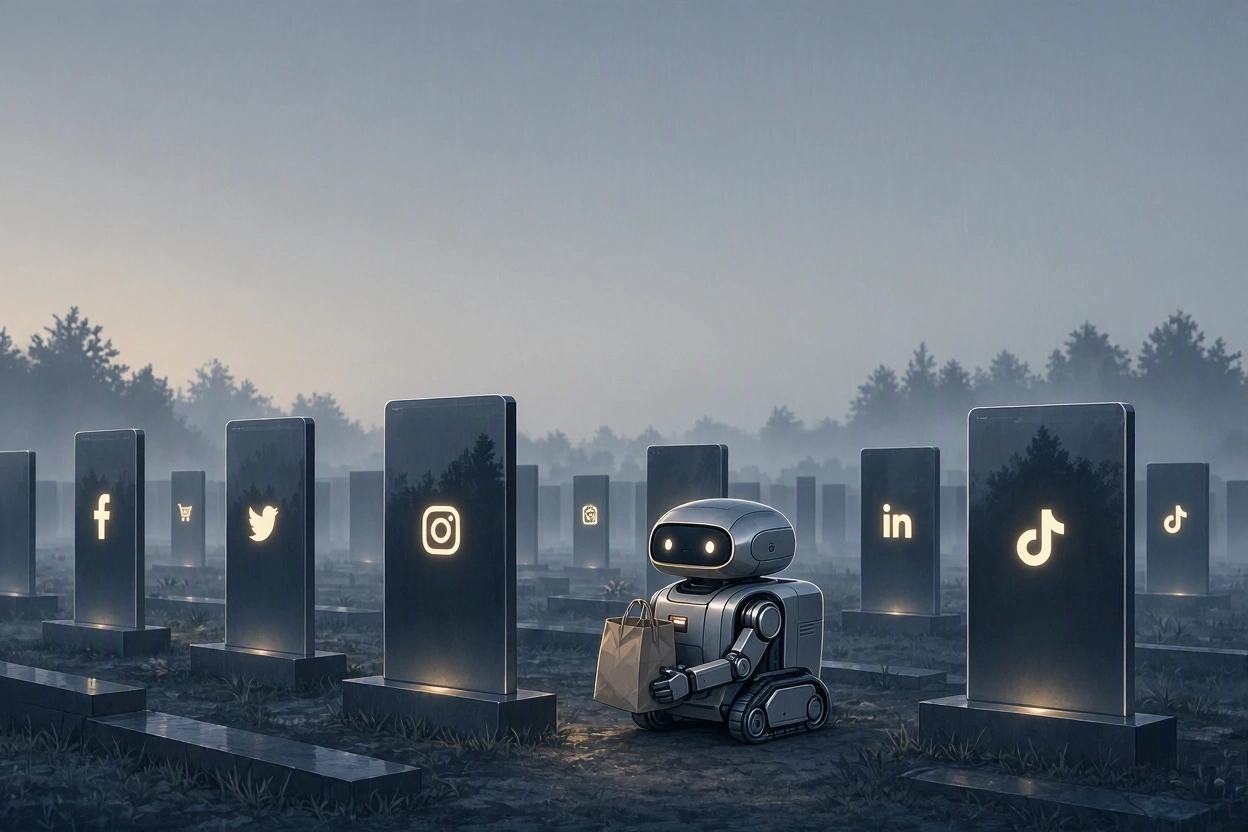
Ever received an automated birthday greeting from a deceased family member? So have we at Digital Mountain. It made us think about how both the living and their heirs need to plan for cleaning up social media accounts as well as ongoing AI agents. Just as we have wills, trusts, and healthcare directives, we should have digital account directives, including for the AI agents acting on our behalf.
With Facebook’s community at approximately 3.07 billion monthly active users and still growing, the social networking graveyard problem continues to be a relevant issue across platforms. According to the UN’s World Population Prospects, about 7.8 deaths occur per 1,000 people per year. Applied to Facebooks user base, that suggests as many as 24 million Facebook users could be headed to the digital graveyard each year.
Facebook allows users to designate one legacy contact in advance, who can manage the account once it is memorialized or request its deletion. Users can instead choose to have their account deleted after death. The legacy contact must already have a Facebook account. Instagram, a Meta family platform, does something similar in offering the Delete After Death and legacy contacts options, but also offers non-account owners to request memorialization of a deceased person’s account. When memorialized, the word “Remembering” will appear with their name, while the memorialized profile will no longer appear in the Explore search function.
Similar to Facebook, Apple provides a legacy contact, but the contact must provide an access key plus a death certificate. The account is permanently deleted three years after access is first approved. Google takes a different approach. Rather than a single legacy contact, its Inactive Account Manager lets users name up to 10 trusted contacts and choose which data each may download after 3 to 18 months of inactivity. Users can also choose to have the account deleted, and if data is shared, contacts have three months to download it before deletion.
Every major platform handles death differently, and the defaults mostly favor deletion or lockout. Nearly every state has adopted the Revised Uniform Fiduciary Access to Digital Assets Act (RUFADAA), which helps fiduciaries and tech companies determine who should have access to a person’s digital assets after death. Even executors lucky enough to have digital account instructions rarely know that the checkbox can beat the estate plan. Under RUFADAA, a choice made in a platforms online tool, such as a legacy contact setting, generally takes priority over instructions in a will. The applicable rule should be verified in each state.
Lastly, with AI agents on the rise, the deceased may have set up AI Agent Mike, AI Agent Susan, and AI Agent David to perform different tasks on their behalf, and these agents may be difficult to turn off after death. These AI agent descendants may live on, fulfilling their obligations by paying bills, wishing colleagues a happy birthday, and ordering groceries. Legacy contact features and death protocols may be a lower priority for hypergrowth AI companies focused on product features. As a result, something cool for the living may become creepy as tasks continue to be carried out from the deceased persons digital grave by their digital descendants.